The Bees' Knees
  • The Bees' Knees
  • Press
  • Pictures
  • Contact
  • Beekeeping Blog

An eye for an eye

5/18/2013

0 Comments

 
"Vandals killed thousands of bees in a wrecking spree — and then signed a name to the crime.

They destroyed 20 hives owned by Heather Hills Farm, causing thousands of pounds worth of damage and potentially killing up to 200,000 bees...

"The blow comes just weeks after the farm, which has its headquarters at Bridge of Cally, launched an adopt a bee scheme to raise awareness of declining numbers of honey bees. The farm, which was founded in 1945, has already been forced to battle poor summers and harsh winters which have seen its population cut by half prior to the attack.

Managing director Mark Noonan said the damage was discovered on Thursday but may have occurred any time after May 1. He added it was too early to tell how many of the hives had been killed off due to the vandals."


Vandals may have killed 200,000 bees
By Kirsty Topping
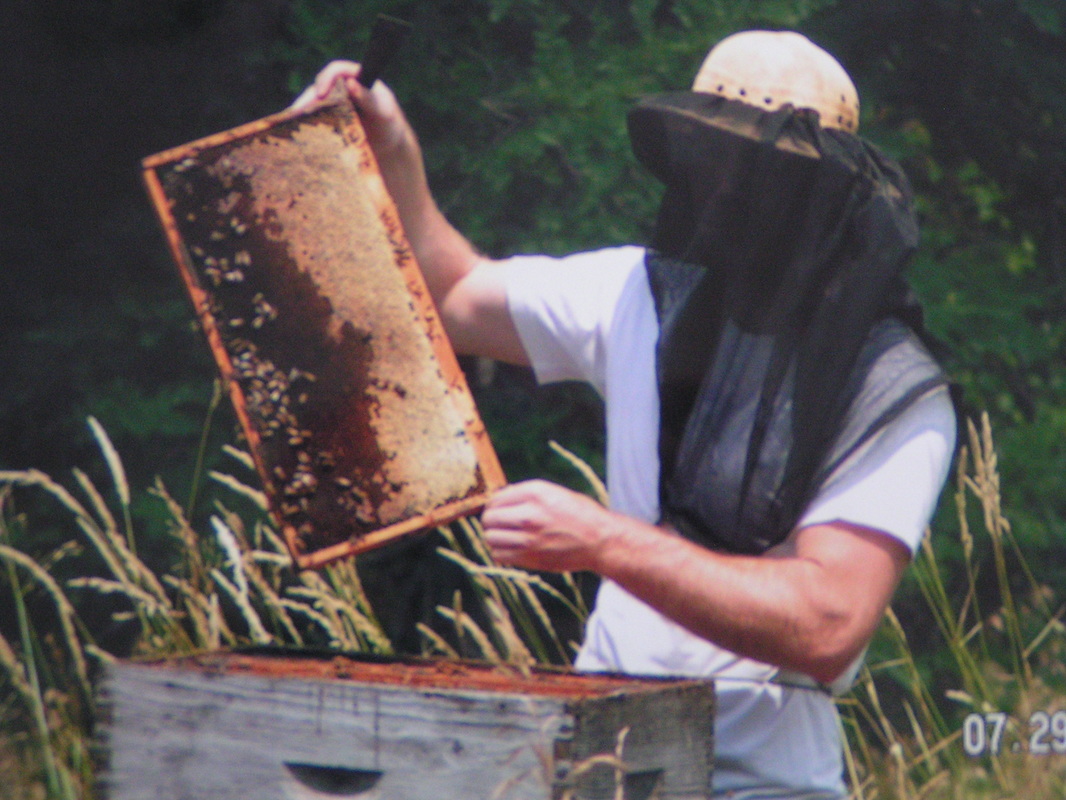
0 Comments

Learning beehavior

4/9/2013

0 Comments

 
"Bumblebees may not have the large, highly-developed brains that certain other animals possess – us extremely intelligent primates, for example – but they can perform surprisingly sophisticated tasks, like using logic and picking up cues from their fellow bees.  Scientists at the Zoological Society of London have been examining social learning in bees and they have published their findings in the journal Current Biology.

As part of their experiment, the researchers placed a number of artificial flowers in 'flight arenas'.  Blossoms of one particular color had been baited with nectar.  The scientists then released a group of bees into the arena while another group of bees was placed on one side of a screen so they could observe as their fellow bees collected nectar from the fake flowers.

Later, the observer bees were released into an arena so they could obtain their own nectar.  Bees in the second group repeatedly chose flowers the same color as those they had seen chosen by the first group, unlike a group of 'naïve foragers' – bees who had not watched the first group.

However, bees that been previously trained to associate the popular flower color with quinine (a substance that bees dislike) disregarded their fellow bee’s preference, opting for other flowers instead.  Just an example of how sometimes being smart means following your gut."


Like People, Bees Learn From Watching One Another
by Alyson Foster
0 Comments

Honey laundering

4/4/2013

0 Comments

 
  "Food-safety experts have found that much of the honey sold in the United States isn't actually honey, but a concoction of corn or rice syrup, malt sweeteners or 'jiggery' (cheap, unrefined sugar), plus a small amount of genuine honey, according to Wired UK.

Worse, some honey — much of which is imported from Asia — has been found to contain toxins like lead and other heavy metals, as well as drugs like chloramphenicol, an antibiotic, according to a Department of Justice news release.

And because cheap honey from China was being dumped on the U.S. market at artificially low prices, Chinese honey is now subject to additional import duties. So Chinese exporters simply ship their honey to Thailand or other countries, where it is relabeled to hide its origins, according to NPR.org.

This international 'honey-laundering' scandal has now resulted in a Justice Department indictment of two U.S. companies and the charging of five people with selling mislabeled honey that also contained chloramphenicol.

Honey Solutions of Baytown, Texas, and Groeb Farms of Onsted, Mich., have agreed to pay millions of dollars in fines and implement corporate compliance measures following a lengthy Justice Department investigation.

'This is a huge deal for the industry. This is the first admission by a U.S. packer,' of knowingly importing mislabeled honey, Eric Wenger, chairman of True Source Honey, told NPR. True Source Honey is an industry consortium with an auditing system to guarantee the actual origin of honey.

Honey isn't the only food product subject to impurities and mislabeling. Olive oil is often cut with cheaper oils and sold at premium prices, a practice that's expected to expand as a shortage of the oil (caused by a 2012 drought in southern Europe) hits global markets."


'Honey Laundering' an International Scandal, Experts Say
Marc Lallanilla

0 Comments

The end of the line

3/25/2013

0 Comments

 
"If you like almonds, then 2013 brought some bad news. Each year, honeybees from across the country make the trek to California, which grows 80 percent of the world’s almonds, to pollinate the almond crop. But bees have been dying in unusually large numbers for several years now, and this year appears worse than most.The problems we face if we don’t have healthy populations of pollinators, particularly honeybees, extend beyond almonds. Three fourths of the top crops grown in the world require animals – mostly insects – for pollination. Odds are that most of your favorite fruits, nuts and melons are pollinated by honeybees.

Across the pond, the European Union has made major strides in shedding light on the role of certain pesticides in honeybee deaths. In fact, the European Commission has proposed a two-year ban on these pesticides. Meanwhile, at home, beekeepers remain frustrated that the U.S. government is not as forward-thinking. And, for another year, the saga of bee deaths continues.

The pesticides in question are called neonicotinoids. It’s a mouthful, but the root word is 'nicotine,' because they are chemically similar to the addicting tobacco compound. The most common of these is a pesticide called imidacloprid. Two others are clothianidin and thiamethoxam...


"When first introduced, neonicotinoids were thought to be relatively 'environmentally friendly' pesticides. Often they can be applied without spraying, by either treating seeds prior to planting or drenching the soil. The pesticides are taken up by and spread throughout the plants. Every part of the plant – including the pollen and nectar – contain pesticide residues. In theory, these chemicals will only poison 'bad bugs' that eat the plants.

A new report published by the European Union’s European Environment Agency chronicles a similar story as it unfolded in France. Back in the 1990s, French beekeepers noticed their bees dying in unprecedented numbers and they connected it to a then-new pesticide used in sunflowers, imidacloprid.

Nailing down the science on how much imidacloprid it takes to kill a bee and how much imidacloprid bees are exposed to was not easy. First, the amounts of imidacloprid in pollen and nectar fell below Bayer’s detection limit of 10 ppb. A decade later, France’s Scientific and Technical Committee for the Multifactor Study of the Honeybee Colonies Decline (CST) validated findings that the pesticide showed up in the pollen of treated sunflowers and maize at the rates of 3.3 ppb and 3.5 ppb, respectively, and in the nectar of treated sunflowers at 1.9 ppb...


"Although there’s little private citizens can do, beyond submitting comments to the EPA about these pesticides, contacting your representatives, and perhaps even getting your own beehive, you might be surprised to find out that these toxic pesticides are widely available for home use. Bayer sells imidacloprid in products sold for use on roses, flowers, shrubs, trees (even fruit and nut trees!), and lawns. Even the flea treatment Advantage sold for your pet contains it!

If you use a landscaping service or hire an arborist, they might have access to even more potent forms of these pesticides. Be sure you know what they are using – and remember that the bees are consuming any nectar or pollen produced by your plants, even if you think of those plants as non-edible."


Without honeybees, we may cease to be
By Jill Richardson


0 Comments

Bees and politics

2/21/2013

0 Comments

 
"Saving bees is a fashionable cause. Bees are under pressure from disease and habitat loss, but another insidious threat has come to the fore recently. Concern in conservation and scientific circles over a group of agricultural insecticides has now reached the policy arena. Next week, an expert committee of the European Union (EU) will vote on a proposed two-year ban on some uses of clothianidin, thiamethoxam and imidacloprid. These are neonicotinoids, systemic insecticides carried inside plant tissues. Although they protect leaves and stems from attack by aphids and other pests, they have subtle toxic effects on bees, substantially reducing their foraging efficiency and ability to raise young.

Whatever the EU decision, this vote will not be the end of the story. The proposed ban will buy some time for scientists and policy-makers to understand more about how neonicotinoids affect bee populations. For despite what both sides of the argument say, the link between bee declines and neonicotinoids is far from clear. I gave evidence to a UK parliamentary inquiry on the issue late last year, and my experience offers a useful window on how science informs public debate and policy-making — and, in the case of the public debate, how it does not...

The assertion that a ban on neonicotinoids in Europe will save bees from extinction is absurd. There are bee species around the world in genuine danger of extinction, such as the once-common rusty-patched bumblebee in the United States, which has vanished from 87% of its historic range since the early 1990s. Diseases, rather than pesticides, are suspected of driving that decline. And although there have been dramatic falls in the numbers of managed honey bee Apis mellifera colonies in some countries, it remains a widespread and common bee, not in imminent danger of extinction."


Bees, lies and evidence-based policy
by Lynn Dicks


You could say the same about the government/media hysteria over global warming or what makes for  a healthy diet.  Gun control, abortion, immigration, health-care, you name it... the government seems to jump on whatever bandwagon it can find.  Then they ask (I should say force) you and me to pay for it all.
0 Comments

Bees and pesticides in Europe

2/6/2013

0 Comments

 
"Europe has sided with the bees and wants to put a ban on insecticides, but MEP Robert Sturdy says this could reduce yields for some key crops by 20% and cost the EU economy up to 4.5 billion euros a year and 50,000 farming jobs.

Robert Sturdy, MP The European Commission has presented draft proposals recommending the end of three vital insecticides, Mr Sturdy, MEP for this region, says.

The EU proposals follow a report by the European Food Safety Authority into the affect these chemical products have on bee health. Three insecticides would be affected, clothianidin, imidacloprid and thiametoxam. The Commission proposes that farmers would be banned from using these neonicotinoid insecticides on crops that are attractive to bees including rapeseed, sunflowers, maize and cotton.

If the Member States of the EU agree with this discussion paper, then the Commission would like the ban in place by July and for it to be in effect for two years before a review.

The UK Department for Environment, Food and Rural Affairs (Defra) after reviewing the evidence last year, rejected a ban on neonicotinoids. It stated that the evidence was not conclusive and that further research was required before changing any legislation."


Bees get the bird from our MEP
from: www.cambridge-news.co.uk

0 Comments

Who to believe?

1/31/2013

0 Comments

 
"The European Commission has proposed that member states restrict the use of certain classes of pesticide that are believed to be harmful to bees.

Sprays that use neonicotinoid chemicals should only be used on crops that are not attractive to the insects they said.

The sale of seeds treated with these chemicals should also be prohibited.

Bayer, one of the companies who make the pesticides, says they are convinced they can be used without harm to bees."


EU says pesticides linked to bee decline should be restricted
By Matt McGrath


I don't trust either one of them.
0 Comments

What they say in Europe

1/22/2013

0 Comments

 
"Europe’s top food safety agency may be closer to nailing three old suspects for a mystery that goes back almost a decade: what’s been killing off honeybees? But there is still work to do.

For now, the European Food Safety Authority (EFDA) has concluded that three neonicotinoid class insecticides pose unacceptable hazards to bees. The three include clothianidin, imidacloprid and thiamethoxam.

The three insecticides — approved for use in the United States — are said to damage bees by contaminating dust and collecting as residue on nectar and pollen, the new EFSA report says."


Top European Food Safety Agency Names Suspects for Bee Colony Collapse
By Dan Flynn
0 Comments

Why would they lie?

1/18/2013

0 Comments

 
"Three reports by Europe’s food-safety body have stoked controversy over the possible links between the use of neonicotinoid insecticides and declining bee populations. One leading insecticide manufacturer has attacked the reports, calling them 'hurried and inadequate'.

A number of scientific studies have linked neonicotinoids to adverse effects on bee colonies (see Nature video) but some researchers believe that the drop in bee numbers seen in the United States, Europe and elsewhere is attributable to a combination of factors."


Reports spark row over bee-bothering insecticides
Pesticide manufacturer brands risk assessment ‘hurried and inadequate’

by Daniel Cressey


0 Comments

Impossible!

1/11/2013

0 Comments

 
"There may be too many bees in the capital, the London Beekeepers Association (LBKA) has said. The association has criticised an initiative by a business group offering hives to central London firms.

InMidtown, which represents firms in Holborn, Bloomsbury and St Giles, said its scheme had seen a 40% increase in honey produced in the last year.

But the LBKA dismissed the project as 'bee bling' saying firms should focus their spending on planting forage.

LBKA secretary Angela Woods said: 'There are a finite number of green spaces in London. It could get to the point where the bees are not sustainable.  London's bee population is going up but honey yields in London are going down and we need to ask is it because there is not enough forage.'"


London bee numbers 'could be too high'
www.bbc.co.uk


Plant more bee forage.
0 Comments
<<Previous

    Author

    Billy Craig
    Beekeeper/ Entomologist

    Picture

    Archives

    May 2013
    April 2013
    March 2013
    February 2013
    January 2013
    December 2012
    November 2012
    October 2012
    September 2012
    August 2012
    July 2012
    June 2012
    May 2012
    April 2012
    March 2012
    February 2012
    January 2012

    Categories

    All
    Advice Column
    Africa
    Aphrodisiacs
    Apitherapy
    Atheism
    Bats
    Bears
    Bee Breeding
    Bee Culture
    Beekeeping Stories
    Bee Removal
    Bees
    Bee Stings
    Bee Story
    Bee Venom
    Bible
    Brazil
    Brood
    Buddha
    California
    Canada
    Charles Martin Simon
    China
    Chinese Honey
    Chuck Norris
    Colony Collapse Disorder
    Creation
    Dance
    Dandelions
    Deer
    Demaree Method
    Diet
    Dogs
    Drones
    Drug Companies
    Drugs
    Easter
    E.B. White
    Education
    Einstein
    Emily Dickinson
    Europe
    Evolution
    Experiments
    Famous Beekeepers
    Feeding
    Fibonacci Sequence
    Flies
    Florida
    Foulbrood
    Georgia
    Global Warming
    Golden Raintree
    Government
    Hawaii
    Hibernation
    Hive Manipulation
    Honey
    Honey Plants
    Illinois
    Insects
    Israel
    Killer Bees
    Louisiana
    Mead
    Micheal Mac Giolla Coda
    Michigan
    Minnesota
    Money
    Monkeys
    Nevada
    New York
    North Carolina
    Ohio
    Patriotism
    Penguins
    Pesticides
    Pests And Diseases
    Philippines
    Pictures
    Poems
    Pollen
    Pollination
    Propolis
    Queen Bees
    Royal Jelly
    Small Hive Beetles
    Smoke
    South Carolina
    Sugar
    Supersedure
    Swarms
    Taxes
    Tennessee
    Texas
    Tuberculosis
    Urban Beekeeping
    Utah
    Varroa Mites
    Walt Wright
    Washington D.c.
    Wax
    Winnie The Pooh
    Winter
    Yellow Jackets

    RSS Feed

Powered by Create your own unique website with customizable templates.
