The Bees' Knees
  • The Bees' Knees
  • Press
  • Pictures
  • Contact
  • Beekeeping Blog

Swarm time

5/7/2013

0 Comments

 
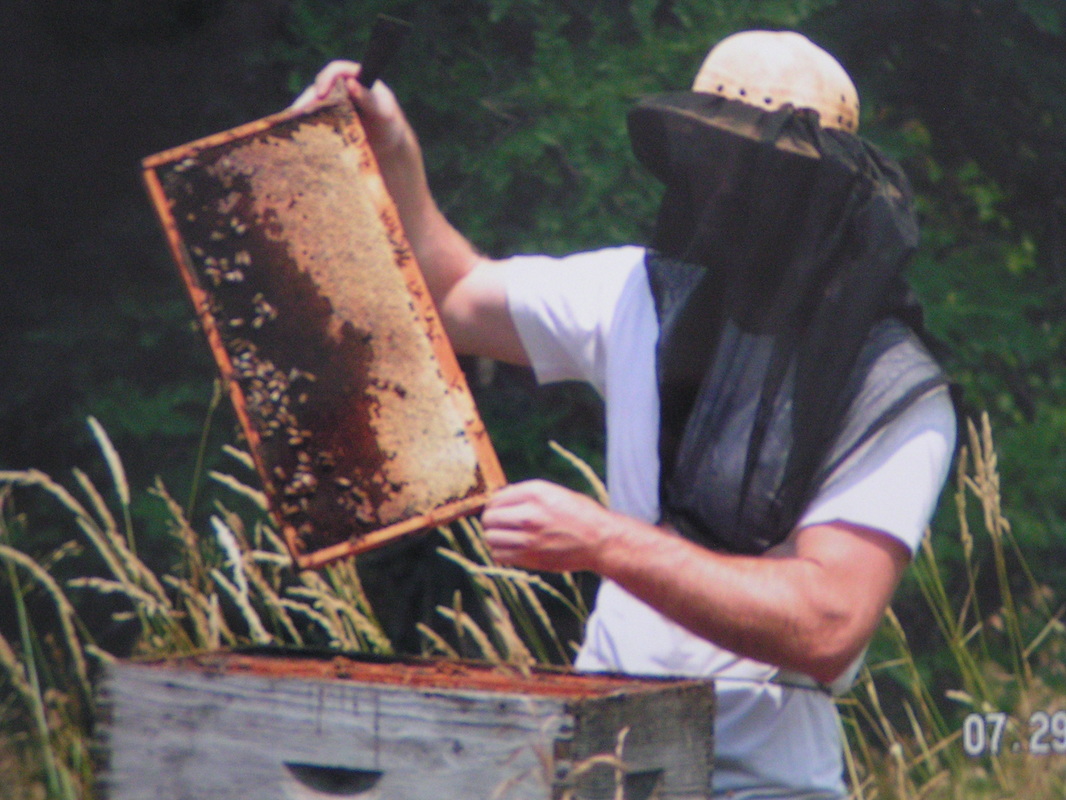
"It was the biggest beehive that that Ogden beekeeper Vic Bachman has ever removed — a dozen feet long, packed inside the eaves of a cabin in Ogden Valley. 'We figure we got 15 pounds of bees out of there,' said Bachman, who said that converts to about 60,000 honeybees.

Bachman was called to the A-frame cabin last month in Eden, Utah. Taking apart a panel that hid roof rafters, he had no idea he would find honeycombs packed 12 feet long, 4 feet wide and 16 inches deep.

The honeybees had been making the enclosed cavity their home since 1996, hardly bothering the homeowners. The cabin was rarely used, but when the owners needed to occupy it while building another home nearby, they decided the beehive wasn't safe for their two children. A few bees had found their way inside the house, and the hive was just outside a window of a children's bedroom.

They didn't want to kill the honeybees, a species in decline that does yeoman's work pollinating flowers and crops.

So they called Bachman, owner of Deseret Hive Supply, a hobbyist store that can't keep up with demand for honeybees. Bachman used a vacuum cleaner to suck the bees into a cage...


"Utah calls itself the Beehive state, a symbol of industriousness. Whether this was Utah's largest beehive is unknown, but Bachman said it would rank high.

"'It's the biggest one I've ever seen,' he said. 'I've never seen one that big.'

He used smoke to pacify the bees, but Bachman said honeybees are gentle creatures unlike predatory yellow jackets or hornets, which attack, rip apart and eat honeybees, he said.

'They just want to collect nectar and come back to the hive,' he said. 'Most people never get stung by honeybees — it's a yellow jacket.'"


Utah cabin had uninvited guests _ 60,000 bees
By PAUL FOY


For beehive removal in the Detroit area, look here.


0 Comments

Bees in trees like dogs with fleas

9/1/2012

0 Comments

 
"I am interested in having a swarm of bees removed from a tree trunk in my yard. The bees are housed in a hole in my tree (about 1 foot diameter) that is only about 4 foot up from the ground. Is this something you would be able to assist with, and if so, how much do you charge?  Thank you."  - Dan


Thank you, sir , for contacting me.  You're a little ways out of my territory, as far as driving distance goes.  The best I can do is give some advice. 

I don't know how bothersome these bees are to you.  There's a high probability that they will die over the winter, which isn't too far away now.  The easiest thing to do is nothing.

However, if you really want them gone now, you may be able to find a willing beekeeper in your area at beesource.com.  If you search under "Swarm Removal", they have a list of beekeepers in Michigan that remove bees and where they are located.

Finally, if the insects are not honey bees, but rather  some other sort of stinging, flying insect (wasp, hornet, yellowjacket), I would recommend killing them yourself.  This involves taking a can of Raid Wasp/Hornet Killer (or its equivalent), going out to the tree shortly after dusk on a cool evening, and spraying the can in the tree very liberally.  Leave quickly, and you may avoid getting stung.

I hope this helps in some way.

Billy Craig
0 Comments

Ground bees

8/22/2012

0 Comments

 
"Hi,
I have a daycare out of my home... and we have a bee problem in the front yard that's getting pretty bad. There seems to be multiple holes in the ground that they are coming from but I can't even get close enough to really assess the situation. Do you have any suggestions on how to deal with this? Last night I poured boiling water down what I thought were the two main holes, but this morning they're still there."

-Grant


Hi Grant,
It sounds like yellow-jackets to me.  They usually live in the ground.  Boiling water would only kill the few insects that contacted it. 
A can of Raid Hornet and Wasp Killer sprayed in the hole just after dark may do the trick.  I think they may also have some smoke bomb-type things that you could drop in the hole after dark.  The main thing is to do it after dark when all the bugs are at home and not flying around.  Plus, these colder nights make them less active, so you're less likely to be stung in the process.  They will still come after you though, so be quick and careful.
Multiple entrances may mean multiple nests, so you may have to get each one individually.
Good luck with it.  Let me know if you need more help.

-Billy, The Bees' Knees Bee Removal Services
0 Comments

What is it?

8/18/2012

0 Comments

 
" Yellowjackets are often mistaken for bees because they are similar in size and appearance, but are actually wasps. The yellow and black insect crawling on your soda can is likely a yellowjacket, which feeds on sweet-tasting liquids, generally plant sap or nectar from flowers or fruit.

And unlike bees, which are fuzzy and can sting only once, yellowjackets look shiny and can have bad attitudes.

Yellowjackets are social insects and generally live in colonies. They build paper nests underground, in trees or on buildings. When a nest is disturbed, they may attack en masse and inflict enough stings that they can be dangerous to people sensitive to the venom.

They are members of the Vespidae family, which also includes hornets and paper wasps. All build their nests of paper, can sting repeatedly and will defend their homes.

But they are not completely bad guys. They eat other insects, many of which are also agricultural pests, and they pollinate flowers and vegetables."

A bee or not a bee? Hot, dry summer is ideal for stinging insects
By Gloria Wright
0 Comments

Bee sting facts

7/28/2012

0 Comments

 
"Almost all available advice about stings is sensational or emphasizes allergies. Very little of that advice admits that bee stings are pretty insignificant most of the time, causing little more than some excitement and temporary minor pain, or that some people actually seek out bee stings for their beneficial effects."

What Everyone Needs to Know About Bee Stings
from http://www.honeybeeworld.com/misc/stings.htm
0 Comments

I've been stung!

7/18/2012

0 Comments

 
"For most people, the buzzing sound of bees is a caution to keep your distance.

"Even though they are armed with intimidating stingers, bees play an important role in our ecosystem by pollinating flowers, fruits and vegetables and keeping our crops growing from year to year.

“'I have never been stung by a honeybee. The only thing I have ever been stung by is a brown hornet if I disturb their nest. Other than that, they will never sting you,' she said. 'If you are stung by a bumblebee, it is because it went down your shirt and got confused; it did not attack you. Yellow jackets are nasty creatures, but you will only get stung if you go near one of their nests. Honeybees are just so nonaggressive.'"  Carver's Claire DeLoid.


Carver's Claire DeLoid encourages residents to preserve bee habitats
By Brittany Burrows

0 Comments

Global warming strikes again!

7/4/2012

1 Comment

 
A South Carolina news team blames mild winter for increase in bees and bee attacks.

http://news.yahoo.com/video/weather-15749664/weather-could-be-to-blame-for-spike-in-bees-29876697.html


If bees are a problem in your garden, yard, or house, look here for help.
1 Comment

Happy April 1st.

4/1/2012

0 Comments

 
"I'm sure all of us that hunt or fish have some stories that weren't funny at the time but we can see the humor in them now.
Last sat. my pastor and a buddy of mine went trout fishing and my pastor pushed a limb out of the way and it had a hornet nest in it. He took off running down the creek and only got stung once. My buddy ran into the swarm and got stung 13 times and then realized his glasses had fallen off so he went back to get them and got popped again. My pastor told him 'you know I was praying for you all the time'. My buddy told him I ain't as dumb as I look I can tell the difference between praying and laughing."

Funny Bee Sting Stories
No. GA. Mt. Man

Notice in these stories that it's not honey bees doing the stinging.  The culprits are usually hornets and yellow jackets.
0 Comments

To bee or not to bee?

1/27/2012

0 Comments

 
Not every bee you see is a bee.  Some are actually flies.  Others, of the stinging variety, are probably yellow-jackets, especially if they're coming at you from the ground.  Many people find themselves being attacked by "bees" while mowing the lawn or otherwise disturbing the ground.  These attackers are actually the yellow-jackets, and not bees at all.  In fact, unless you find yourself playing around in front of a beehive, you probably are not going to be stung by a honeybee.  The stinging culprit is most likely some other type of insect.
0 Comments

    Author

    Billy Craig
    Beekeeper/ Entomologist

    Picture

    Archives

    May 2013
    April 2013
    March 2013
    February 2013
    January 2013
    December 2012
    November 2012
    October 2012
    September 2012
    August 2012
    July 2012
    June 2012
    May 2012
    April 2012
    March 2012
    February 2012
    January 2012

    Categories

    All
    Advice Column
    Africa
    Aphrodisiacs
    Apitherapy
    Atheism
    Bats
    Bears
    Bee Breeding
    Bee Culture
    Beekeeping Stories
    Bee Removal
    Bees
    Bee Stings
    Bee Story
    Bee Venom
    Bible
    Brazil
    Brood
    Buddha
    California
    Canada
    Charles Martin Simon
    China
    Chinese Honey
    Chuck Norris
    Colony Collapse Disorder
    Creation
    Dance
    Dandelions
    Deer
    Demaree Method
    Diet
    Dogs
    Drones
    Drug Companies
    Drugs
    Easter
    E.B. White
    Education
    Einstein
    Emily Dickinson
    Europe
    Evolution
    Experiments
    Famous Beekeepers
    Feeding
    Fibonacci Sequence
    Flies
    Florida
    Foulbrood
    Georgia
    Global Warming
    Golden Raintree
    Government
    Hawaii
    Hibernation
    Hive Manipulation
    Honey
    Honey Plants
    Illinois
    Insects
    Israel
    Killer Bees
    Louisiana
    Mead
    Micheal Mac Giolla Coda
    Michigan
    Minnesota
    Money
    Monkeys
    Nevada
    New York
    North Carolina
    Ohio
    Patriotism
    Penguins
    Pesticides
    Pests And Diseases
    Philippines
    Pictures
    Poems
    Pollen
    Pollination
    Propolis
    Queen Bees
    Royal Jelly
    Small Hive Beetles
    Smoke
    South Carolina
    Sugar
    Supersedure
    Swarms
    Taxes
    Tennessee
    Texas
    Tuberculosis
    Urban Beekeeping
    Utah
    Varroa Mites
    Walt Wright
    Washington D.c.
    Wax
    Winnie The Pooh
    Winter
    Yellow Jackets

    RSS Feed

Powered by Create your own unique website with customizable templates.
